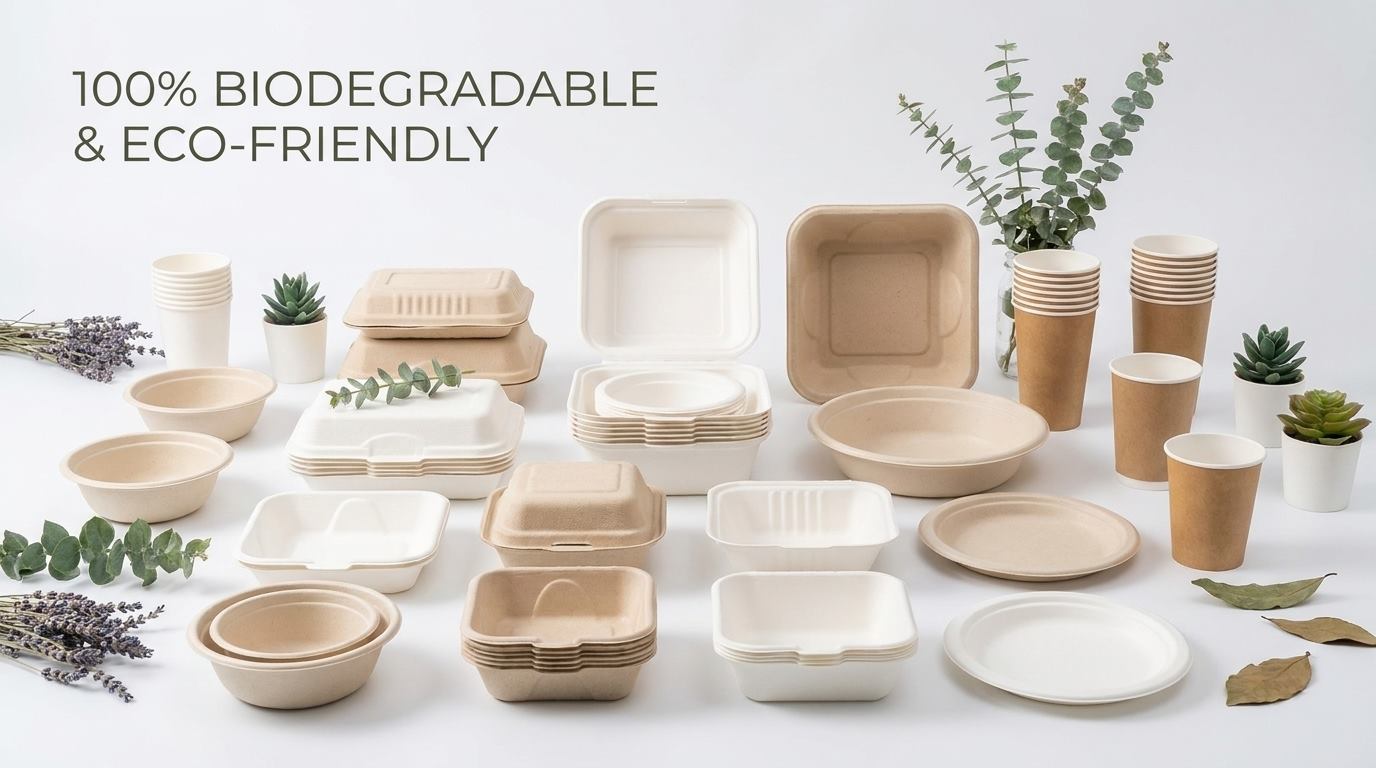
The European Union's Single-Use Plastics Directive (Directive 2019/904/EC) is one of the most consequential pieces of packaging regulation in history. Since it came into full effect in July 2021, it has reshaped the global supply chain for disposable tableware, packaging, and food service products. For B2B buyers who import or distribute food-service packaging in European markets — or who supply businesses that do — understanding this directive is non-negotiable.
📌 This guide summarizes the key provisions of the EU SUP Directive as applicable to eco-packaging buyers. It is not legal advice. Always consult a qualified legal expert for country-specific compliance requirements.
What is the EU SUP Directive?
The Single-Use Plastics Directive targets the 10 most common single-use plastic items found on European beaches and in European seas, plus all single-use plastic fishing gear. These items together account for 70% of all marine litter in the EU. The directive covers the full product lifecycle: design, production, labeling, waste management, and extended producer responsibility.
The directive distinguishes between three types of measures depending on the product category: outright bans, consumption reduction targets, and extended producer responsibility (EPR) schemes.
Banned Products (Since July 3, 2021)
The following single-use plastic products are prohibited from being placed on the EU market:
| Product Category | Status | Certified Eco Alternative |
|---|---|---|
| Single-use plastic cutlery (forks, knives, spoons, chopsticks) | BANNED | PLA, CPLA, wooden, bamboo, bagasse |
| Single-use plastic plates | BANNED | Sugarcane bagasse, bamboo fiber, palm leaf |
| Plastic straws | BANNED | Paper, PLA, pasta, bamboo, stainless steel |
| Plastic cotton bud sticks | BANNED | Paper or cardboard sticks |
| Plastic balloon sticks | BANNED | N/A (exempted for industrial use) |
| Oxo-degradable plastics (any product) | BANNED | Certified biodegradable alternatives |
| Food containers made of expanded polystyrene (EPS) | BANNED | PLA, bagasse, paper-based containers |
| Beverage cups made of expanded polystyrene (EPS) | BANNED | PLA cold cups, paper hot cups |
⚠️ Important: "Oxo-degradable" plastics (plastics with additives that cause fragmentation into microplastics) are banned under the directive. These are NOT the same as certified compostable or biodegradable plastics. Ensure your suppliers do not use d2w, EPI, or similar additives.
Restricted Products: Consumption Reduction Targets
Some products are not banned outright but are subject to national consumption reduction measures. EU member states must demonstrate measurable reduction by 2026 compared to 2022 levels:
| Product | Measure Type | Notes |
|---|---|---|
| Single-use plastic food containers (takeaway, ready-to-eat) | REDUCTION TARGET | Must be reduced by 2026; member states may impose charges or bans |
| Single-use plastic beverage cups (not EPS) | REDUCTION TARGET | France bans; others must reduce via national measures |
| Wet wipes containing plastic | LABELING REQUIRED | Must carry "contains plastics" mark |
| Tobacco filters | EPR | Producers responsible for cleanup costs |
| Beverage containers ≤3L | DESIGN REQUIREMENT | Caps/lids must be tethered to container by 2024 |
Country-by-Country Implementation: Key Markets
France
France has gone further than the base directive requirements. The Loi Anti-Gaspillage pour une Économie Circulaire (AGEC) mandates that restaurants serving ≥20 guests must offer reusable tableware from January 2023. Single-use disposables are banned at fast-food restaurants from 2023. All disposable packaging must carry compostability certification.
Germany
Germany implemented the SUP Directive with additional EPR obligations. From January 2023, operators offering takeaway food in single-use containers must also offer a reusable alternative ("Mehrwegpflicht"). Retailers must charge for single-use cups. The Verpackungsgesetz (Packaging Act) requires manufacturer/importer registration with the LUCID system.
Netherlands
The Netherlands bans all SUP items and requires producers to pay for cleanup of littered items. A national deposit return system (DRS) for plastic bottles and cans launched in April 2023.
UK (Post-Brexit)
The UK enacted its own Single-Use Plastics ban (effective October 2023) covering plates, trays, bowls, cutlery, balloon sticks, polystyrene cups, and food containers. The rules are broadly aligned with the EU SUP Directive but are separate legislation.
What "Certified Eco Alternative" Actually Means
A critical point that many buyers miss: replacing banned plastic products with non-certified alternatives is not sufficient. For example, a product labeled "plant-based" or "biodegradable" without third-party certification may still be considered non-compliant in certain EU markets. The key certifications regulators and retailers recognize are:
- EN 13432 — European standard for industrial compostability of packaging
- OK Compost Industrial / HOME (TÜV Austria) — Internationally recognized compostability marks
- DIN CERTCO — German certification body for compostable products
- Seedling logo (European Bioplastics / DIN CERTCO / Vinçotte) — Widely recognized on EU retail shelves
✅ All Verdantidemat fully degradable products carry EN 13432 and ASTM D6400 certifications. Request our certification documents when placing an inquiry.
Practical Checklist for B2B Buyers
If you are sourcing eco-packaging for distribution or use in the EU, here is a practical compliance checklist:
- Confirm your target product is not on the banned list (see table above)
- Request EN 13432 or OK Compost certification documents from your supplier
- Verify the certification number is valid and not expired (check the issuing body's database online)
- Ensure labeling complies with EU SUP labeling requirements (compostability mark, material labeling)
- Check country-specific rules for your target member state — France and Germany have stricter requirements
- Register with national EPR/packaging registries as required (e.g., LUCID in Germany)
- For products with plastic components (e.g., PLA-lined paper cups), verify the entire product is certified, not just one layer
How Verdantidemat Can Help
We manufacture and export certified eco-packaging products from China, purpose-built for compliance in regulated markets. Our product range includes certified compostable cutlery, food containers, cups, plates, and trays in both 100% degradable (PLA/plant fiber) and semi-degradable (plant starch + PP) formulations.
We provide full documentation packages for EU customs clearance and EPR registration, including: CE certificates, EN 13432 test reports, MSDS sheets, and product composition declarations. Request our compliance document pack with any order inquiry.