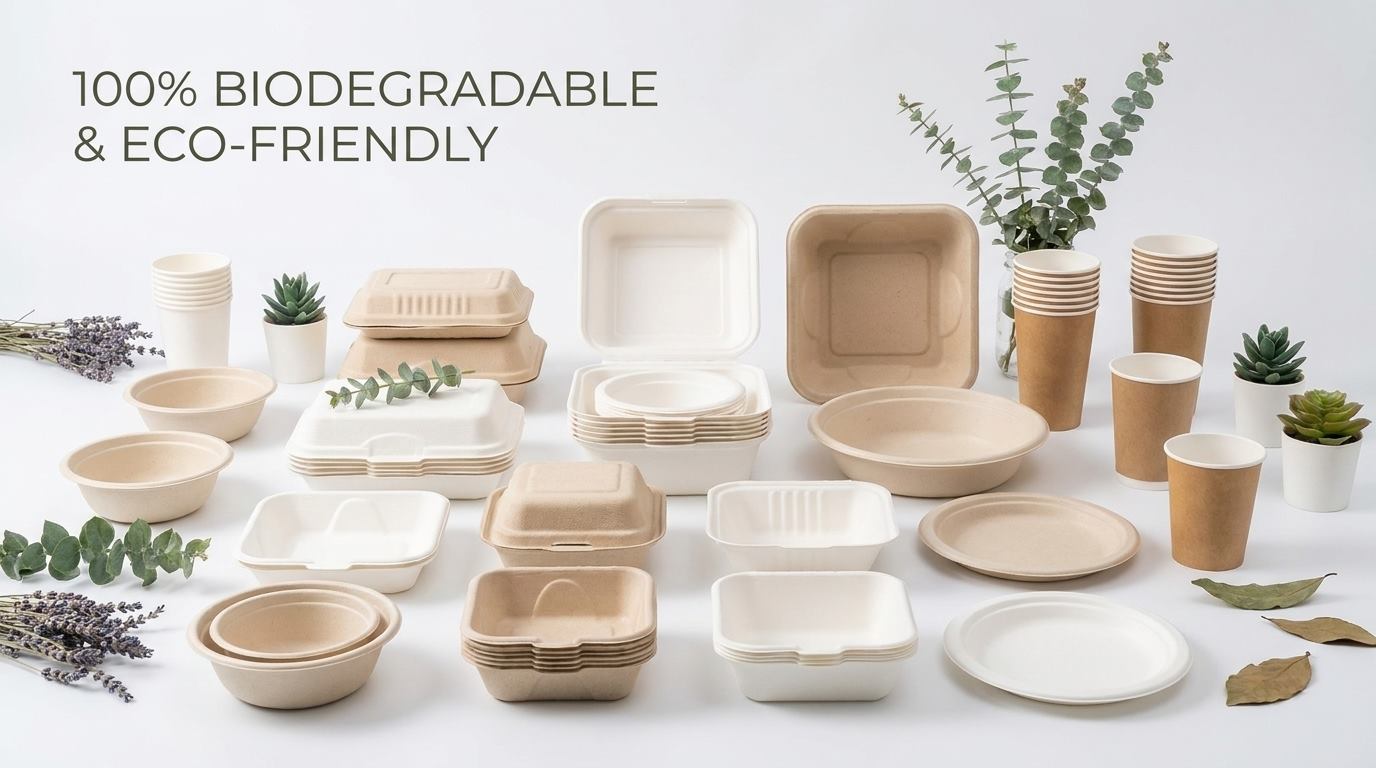
PLA (Polylactic Acid) is a bioplastic derived from fermented plant sugars — typically corn starch, sugarcane, or cassava root. Unlike conventional plastics made from fossil fuels, PLA is manufactured from annually renewable resources and can be industrially composted at end of life. It has rapidly become one of the most commercially important biodegradable materials in the global food packaging industry.
💡 Key fact: PLA is currently the second most produced bioplastic in the world by volume, and demand is growing at approximately 15–20% annually due to global single-use plastic restrictions.
How is PLA Made?
The production process begins with harvesting crops high in starch or sugar — most commonly corn (USA/China), sugarcane (Brazil), or cassava (Southeast Asia). The starch is extracted and converted into simple sugars through hydrolysis. These sugars are then fermented by microorganisms to produce lactic acid. The lactic acid monomers are chemically linked (polymerized) into long chains to create PLA resin pellets, which can then be processed into films, sheets, fibers, or molded products.
The Production Chain at a Glance
- Crop harvest → starch/sugar extraction
- Enzymatic hydrolysis → glucose or fructose
- Bacterial fermentation → lactic acid (L-LA or D-LA)
- Polycondensation → low-MW PLA
- Ring-opening polymerization → high-MW PLA resin
- Pelletizing → ready for manufacturing
PLA vs Conventional Plastic: Key Differences
| Property | PLA | Conventional PET/PS |
|---|---|---|
| Raw material source | Renewable plant crops | Fossil fuels (petroleum) |
| Carbon footprint | ~55–70% lower CO₂ vs PET | High — non-renewable |
| End-of-life | Industrially compostable | Persists 400–1000 years |
| Heat resistance | 55–60°C (standard) | 70–90°C (PET) |
| Clarity/appearance | Crystal clear, comparable to PET | Clear to opaque |
| Food safety | FDA & EU food-contact approved | Approved (varies by grade) |
| Cost | Slightly higher than commodity plastics | Lower (commodity) |
Composting PLA: What Buyers Must Know
The most common misconception about PLA is that it will biodegrade quickly in any environment. This is not accurate. Standard PLA requires industrial composting conditions to break down within a reasonable timeframe. In a home compost pile or conventional landfill, PLA may take many years to degrade meaningfully.
Industrial Composting (Required for most PLA)
- Temperature: 55–70°C sustained for 10–14 days
- High humidity: 50–60% moisture content
- Active microbial environment with regular turning
- Expected degradation: 90%+ within 90 days (EN 13432 standard)
Home-Compostable PLA (emerging grade)
- Modified PLA formulations certified to OK Compost HOME
- Degrades at ambient temperatures (20–30°C)
- Slower: typically 6–12 months in active home compost
- Currently limited availability and higher cost
⚠️ For buyers: Always confirm whether your target market has industrial composting infrastructure. In many developing markets, industrial composting is limited — in those cases, consider plant starch + PP semi-degradable materials as a pragmatic alternative.
Relevant Certifications for PLA Products
When sourcing PLA packaging, always request products certified to at least one of these internationally recognized standards:
| Standard | Region | What it covers |
|---|---|---|
| EN 13432 | Europe (EU) | Industrial compostability for packaging |
| ASTM D6400 | USA | Compostable plastics specification |
| OK Compost Industrial | International (TÜV Austria) | Industrial composting certification |
| OK Compost HOME | International (TÜV Austria) | Home composting certification |
| GRS (Global Recycled Standard) | International | Recycled content verification |
| BPI Certified | USA | ASTM D6400 compostable mark |
PLA Applications in Food Service Packaging
PLA's properties make it well-suited for a specific range of food-service applications. Its natural clarity and stiffness mirror PET, making it the material of choice for:
- Cold cups and cold-drink lids (up to 55°C)
- Salad bowls, deli containers, clamshell boxes
- Cutlery (forks, spoons, knives) for cold and warm meals
- Straws and stirrers
- Food wrapping films (PLA-based biaxial film)
- Portion cups, sauce cups, condiment packaging
Important limitation: Standard PLA is not suitable for hot beverages or hot foods above 55°C. For hot applications (coffee cups, hot soup bowls), heat-resistant PLA grades (CPLA — crystallized PLA) or alternative materials like bagasse (sugarcane fiber) are required.
PLA at Verdantidemat
Our fully degradable product line is manufactured from certified PLA and plant fiber composite materials. All products are certified to EN 13432 and ASTM D6400. We supply food-service businesses, hospitality chains, and wholesale distributors across Southeast Asia, the Middle East, and Europe.
If you are evaluating eco-packaging for your business, we recommend requesting a sample set to test performance in your specific application before placing a bulk order. Our minimum order quantities start from 10,000 units per SKU.